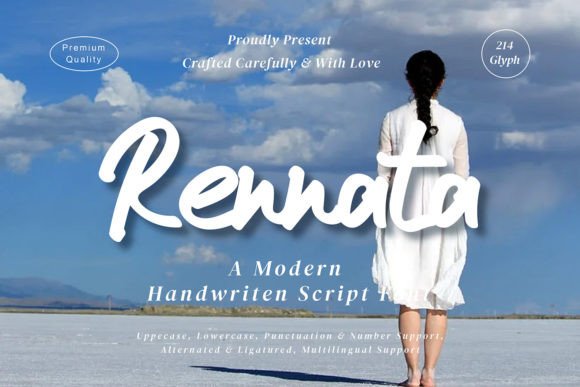
Rennata: A Sweet Handwritten Font for Handmade Charm
It started with a candle label—just one small 2" x 3" rectangle I’d sketched in my notebook, then opened in Illustrator to bring to life. I needed something soft but intentional, romantic but not fussy, joyful without feeling childish. That’s when I typed “Rennata” into my font library and watched the letters flow across the screen like ink from a fine nib pen. Instantly, I knew: this was the gentle script I’d been reaching for.
Rennata is a sweet, cursive handwritten font—fluid, graceful, and full of quiet confidence. It’s not overly ornate or dramatic; instead, it leans into warmth and sincerity. The lowercase ‘g’ curls just so, the ‘y’ has a tender loop, and the capital ‘R’ opens with a soft swell—each detail feels considered, never accidental. As a script font from Script Amp, Rennata carries the polish of a premium typeface while keeping the soul of handmade lettering. It’s the kind of font that makes customers pause—not because it shouts, but because it invites.
I tested Rennata first on soy wax candle labels—“Lavender & Honey,” “Cozy Evening,” “First Snow.” Printed on kraft sticker paper, the font held its shape beautifully at 14pt, with clean edges even after die-cutting on my Cricut Maker. No blurring, no broken terminals. For smaller items—like mini gift tags or tea bag wrappers—I dropped to 10pt and kept spacing generous. Rennata shines best in short phrases, names, titles, and decorative accents—not long paragraphs—but that’s exactly where handmade makers need it most.
It’s equally at home on greeting cards, wedding invitations, and printable wall art. I used it for a set of planner page headers (“Gratitude,” “Today’s Intentions,” “Small Joys”) paired with a light sans serif (Inter or Montserrat) for body text—a classic, breathable pairing that lets Rennata breathe. For digital downloads, I previewed each template in mockups: a chalkboard-style welcome sign, a linen-textured printable quote, a blush-pink birthday card. In every case, Rennata added emotional resonance—softness, sincerity, care—that customers notice before they even read the words.
Seasonal designs are where Rennata truly sings. On holiday gift tags, it turns “To: Mom” into something tender. On farmhouse-style signs, “Gather Here” feels like an open door. For boutique packaging—think cotton drawstring bags or folded tissue wraps—it elevates the unboxing moment without shouting luxury. And yes, it works on mugs and tote bags too: I ran a test print on a white ceramic mug using a sublimation transfer, and the curves stayed crisp at 28pt—even after dishwashing.
Readability matters—especially for physical products. Rennata performs well on stickers and labels down to 8–10pt *if* you’re using high-resolution printing and avoid tight tracking. For cutting machines, always convert text to outlines before exporting SVGs, and double-check swashes or ligatures don’t create unintended breaks in cut paths. I found the standard OTF version included smooth alternates and optional swashes—perfect for adding subtle variation to invitation suites or social media graphics—but kept those turned off for product labels where consistency is key.
Font pairing? Rennata loves contrast. Try it with a clean, low-contrast sans serif (like Poppins or Lato) for modern balance, or a delicate serif (Cormorant Garamond, Playfair Display) for elevated stationery. Avoid pairing it with another script font unless you’re intentionally layering textures—say, Rennata for names and a bolder, more structured script for headings. For shop branding, I used Rennata only for my logo wordmark and tagline (“Hand-poured • Small-batch • Thoughtfully made”), then switched to a neutral sans for all other shop materials—keeping brand identity clear and scalable.
Before using Rennata commercially—whether on physical goods, digital templates, or merch—I checked the license. As a commercial font from Script Amp, it allows unlimited use in both physical and digital products, including resale of printed items and editable design files (like Canva templates or layered PSDs). It supports Latin-based languages and includes basic multilingual glyphs—enough for English, Spanish, French, and German shop listings—but I verified extended language support wasn’t needed for my current product range.
What surprised me most was how often customers commented—not on the font by name, but on the *feeling*. “This label feels like it was written just for me.” “The invitation looks like it holds a secret.” That’s Rennata’s quiet power: it doesn’t distract. It connects. It makes handmade feel *held*.
I’ve since used it across six product lines: lavender-scented candle labels, botanical-themed greeting cards, printable wedding welcome boards, minimalist planner stickers, seasonal tea towel designs, and digital affirmation cards. Each time, Rennata adapts—never overpowering, always enhancing. It doesn’t ask to be the hero of the design. It simply shows up, graceful and grounded, ready to help your handmade story be seen—and felt.
If you’re choosing a script font for real products—not just mood boards or Pinterest pins—Rennata offers reliability with heart. It’s the kind of typeface that reminds you why you make things by hand in the first place: to add meaning, one curve, one word, one carefully chosen letter at a time.