Fullmoon Font: A Playful Script for Handmade Labels & Wedding Stationery
If you’ve ever spent hours tweaking letter spacing on a candle label only to find it looks stiff or lifeless, you know how much the right script font can lift a handmade product. That’s why Fullmoon has become my go-to for projects where warmth and personality matter—without sacrificing clarity or commercial usability. It’s not just another decorative script; it’s a modern, playful script font with bounce, rhythm, and just enough polish to feel intentional—not scribbled.
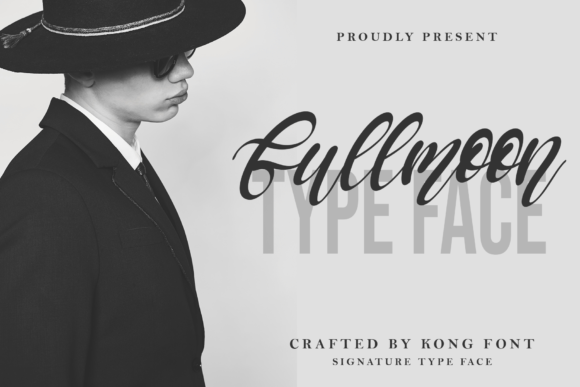
Visually, Fullmoon balances soft curves with confident strokes. The lowercase ‘g’ and ‘y’ have gentle descenders that flow without tangling. Uppercase letters carry subtle flair—think rounded terminals and open counters—so they hold up beautifully at 24pt on a kraft tag or scaled down to 10pt for a mini sticker. It reads like handwriting, but one that’s been carefully designed for real-world use: no awkward joins, no fragile thin lines that vanish when cut on a Cricut or Silhouette, and no excessive swashes that clutter small spaces.
I use Fullmoon most often for physical product labels—especially for artisanal goods like soy candles, bath salts, and small-batch honey. Its readability at 14–18pt means customers can glance and instantly recognize your brand name or scent title (e.g., “Lavender Moon” or “Salt & Sage”). Because it’s clean enough to pair with minimalist packaging, yet expressive enough to stand alone, it helps boutique items feel both approachable and premium—even before someone reads the description.
For wedding stationery, Fullmoon shines on welcome signs, place cards, and foil-stamped invitation suites. Unlike overly ornate scripts that compete with floral motifs or watercolor backgrounds, Fullmoon keeps its charm light and legible. I’ve printed it on textured cotton paper at 20pt for escort cards—and guests consistently comment on how “friendly” and “thoughtful” the typography feels. It also works beautifully as a secondary font in layered SVG designs: think a bold sans serif for the couple’s names paired with Fullmoon for the date or location (“Nashville, TN • June 2025”).
Printable creators will appreciate how Fullmoon performs across digital formats. Whether you’re designing planner stickers, printable wall art, or editable Canva templates, this font renders crisply in PDFs and PNG exports. Its consistent x-height and generous spacing prevent crowding in tight grids—like a set of 2×3 inch affirmation cards or a bundle of seasonal greeting card templates. And because it’s part of the Freebies category, it’s accessible for testing new product ideas without upfront cost—though always verify licensing before bundling into paid digital downloads.
Readability matters most when cutting. I’ve run Fullmoon through my Cricut Maker at sizes as small as 8pt on vinyl stickers—no issues with broken connections or lost details. For laser-cut wood signs or engraved acrylic tags, I stick to 16pt minimum and avoid overlapping letters in custom word art. It cuts cleanly, especially when using the standard OTF version (which is what I’ve found included with Fullmoon). No extra ligatures or stylistic alternates are needed for everyday use—but if your design calls for a subtle flourish, check whether the font includes optional swashes. They’re best reserved for hero text: a single line on a mug wrap, a shop banner, or a social media cover image.
Font pairing is where Fullmoon really sings. As a script font, it pairs naturally with a clean, neutral sans serif—think Montserrat, Inter, or even your system’s default Arial for mockups. That contrast gives structure to handmade branding: Fullmoon carries the voice, while the sans serif handles the facts (ingredients, care instructions, sizing charts). For printables with a vintage or editorial vibe, try it alongside a gentle serif like Lora or Playfair Display—just keep body text in the serif and reserve Fullmoon for headings and decorative accents.
It’s not built for long paragraphs. Don’t use Fullmoon for product descriptions, terms of service, or multi-line ingredient lists. But for short, high-impact phrases? Absolutely. Think: “Hand-poured • Small Batch • Made with Love” on a tea box, “You’re Invited” on a birthday invite, or “Open Daily • 10am–6pm” on a chalkboard-style storefront sign. Its natural rhythm guides the eye without demanding attention—making it ideal for signage that supports, rather than dominates, your space.
Commercial use is straightforward—but essential to confirm. Fullmoon is licensed for use in physical products you sell (candles, mugs, tote bags), digital printables (PDF planners, SVG cut files), and client work (like designing a local bakery’s menu board). Just double-check the license file included with your download: some free fonts restrict resale of unmodified font files or prohibit embedding in apps. As long as you’re using Fullmoon to create original designs—not redistributing the .OTF itself—you’re covered for Etsy listings, Shopify banners, and craft fair displays.
Seasonal projects benefit too. I used Fullmoon last December for holiday ornament tags (“Joy • Peace • Hope”), and again in spring for seed packet labels (“Heirloom Tomatoes • Sow in April”). Its versatility across tones—playful for kids’ birthday kits, elegant for bridal showers, grounded for farmhouse markets—means it earns shelf space in my font library year after year. And because it’s a free font designed with makers in mind, it removes friction between inspiration and execution.
What sets Fullmoon apart isn’t just how it looks—it’s how it behaves in your workflow. It installs quickly, previews reliably in design tools, and scales without distortion. Whether you’re layering it in Procreate for a digital sticker sheet or kerning it by hand in Adobe Illustrator for a luxury soap label, it responds predictably. That reliability builds trust—not just with your customers, but with yourself as a creator who values both beauty and efficiency.
If your current script font feels either too formal or too fragile for daily use, give Fullmoon a try. Use it for the first line on your next product tag. Drop it into a Canva template for an Instagram story highlight. Test it beside your favorite sans serif in a mood board for your next collection. You’ll notice the difference—not in flashiness, but in quiet confidence: the kind that makes handmade goods feel seen, valued, and unmistakably yours.